

One of the prettiest sights in Seoul, which is free to visit, is Seonggyungwan and Munmyo Temple of Confucius, East of Changgyeonggung Palace. It is a stunning place of tranquillity that is also home to an over two-hundred-year-old gingko tree. Let me show you why it’s worth your visit during a trip in Seoul.
This post isn’t sponsored nor commissioned but contains affiliate links (marked with an asterisk *). If you buy/book anything after clicking on them, this doesn’t cost you anything extra but gives me a little commission from qualifying purchases to help keep uploading free travel tips for you on to this blog.


How to get there
It’s easy to get to Munmyo Temple by public transport. The closest bus stop is just a 5-minute walk down the street. And there are constantly buses coming through and multiple bus lines at that.
The bus stop is called Sungkyunkwan Univ. (Entrance) (성대입구).
Alternatively, you can take Seoul metro line 4 to Hyehwa station (혜화), then leave through exit 4. From there, it’s a short 15-minute walk toward SKK University.
- Address: 25-1 Seonggyungwan-ro, Jongno District, Seoul, Südkorea

Entry
There are two different entry points to Munmyo Temple, either from the East (with the parking lot), or the West (at the Sungkyunkwan University campus).
Entry is free of charge.

The Complex
Did you know that munmyo is a general term for a temple of Confucius in Korea? This one in particular is THE primary temple of Confucius.
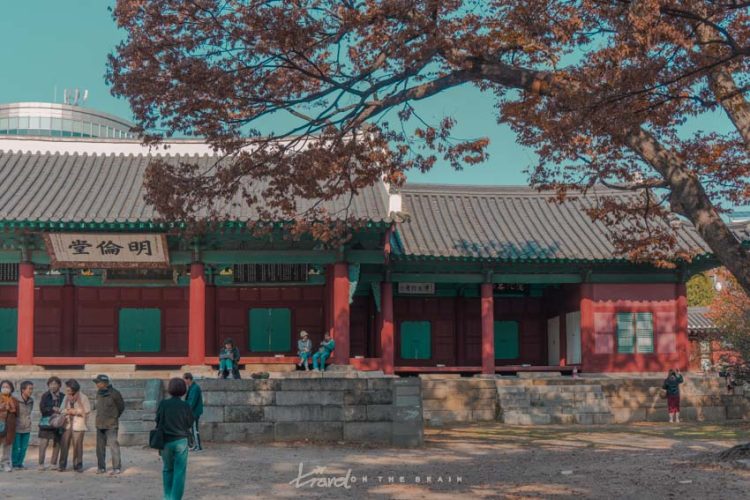
The temple grounds are rather large and house multiple structures, which are not open to the public. The main one, which is operated during ceremonies, is Daeseongjeon, or “Hall of Great Achievement.”
Please note that even when the gates are open during ceremonies like Seokjeon Daeje, you must not walk on the central path nor through the central gate. It is only for the spirit of Confucius and his disciple.
The temple complex is basically divided into two parts. There’s a part reserved for rituals and one originally built for education and studies.
For the latter, two dormitories, known as Dongjae and Seojae, the Confucian lecture hall Myeongnyundang, a library called Cheonggyeongdang, as well as the dining hall Jinsasikdang were built.
The two parts of Daeseongjeon (Shrine Hall) and Myeongnyundang (the Scholar Hall) lie in the South and North respectively and were neatly separated by a wall in the middle. A huge gingko tree grows right in front.
To complete the educational facilities, Jongyeonggak, Hyanggwancheong, Bicheondang halls were built for study and Dongjae together with Seojae were for more private reading rooms.
Further to the Northeast, past the yard, there are smaller buildings, like Yugilgak. Those were used for storage, such as for bows and arrows.There was also a library and dormitories.


The History
Munmyo 문묘 was erected in 1398 and rebuilt in 1407 after a fierce fire, then rebuilt again in the early 1600s after the Japanese invasion.
The facility used to be the centre of Neo-Confucianism, which was the main religion during Joseon times. Besides studying literature, students here also practiced martial arts.

Events
You can visit the temple any time of the year and throughout the day. But there are special events, where the site is transformed for big ceremonies and rituals.
One such iconic event is Seokjeon Daeje, or “Great Rite for Confucius”. It translates to “laying out offerings ceremony”.
It takes place around February and August of the lunar calendar every year, which would translate to March and September in the solar calendar. The festival honours Confucius and great Confucian thinkers in both Korea and China.
What makes it so special is that you can also see music and dance performances in the big Daeseongjeon Hall, which is off limits otherwise. The festival is an important cultural heritage.
The dancing especially is super unique. Known as the Eight-Row Dances (Parilmu), it to this day preserves the original performance and Ceremonial.


The Gingko Tree
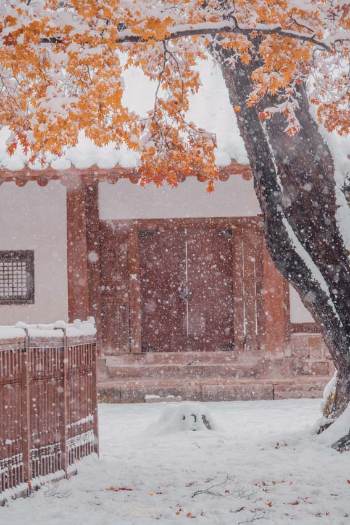
Besides its historical significance, what makes Munmyo even more special is the gigantic gingko tree in the yard in front of Myeongnyundang lecture hall.
In Autumn, they are a wonderful vibrant yellow long into November. The ground is then also covered in the fallen leaves. A beautiful sight!
The tree is over 400 years old and was planted in 1519 to symbolise the importance of knowledge. It’s a typical Confucian practice. It is about 26 metres in height and has a girth of 12.09 metres.
It was teacher Yoontak of Dongji-seonggyungwansa who planted the tree during King Jungjong’s reign. He called it ‘Munheung’.

More Seoul travel tips
- What fun things to experience in Hongdae, Seoul
- What non-spicy food to look for in Seoul
- Day trip to Sokcho and Seoraksan National Park
