Coming to Seoul as a foreigner, especially for the first time, might mean some cultural complications for you. There are common courtesies and societal expectations you could not be aware of – and I certainly was glad to know about a few faux pas tourists in Seoul do in advance, so as not to make them in the first place.
So, if you want to avoid these cultural mistakes in Seoul yourself, here are some tips I picked up and found helpful to know.
This post isn’t sponsored nor commissioned but contains affiliate links (marked with an asterisk *). If you buy/book anything after clicking on them, this doesn’t cost you anything extra but gives me a little commission from qualifying purchases to help keep uploading free travel tips for you on to this blog.

Don’t Press the Traffic Light Button
Traffic lights usually come with a button and there’s some Korean text around. DO NOT PRESS THEM. They are not for making the lights turn green for pedestrians – only in some rare cases.
Instead, they are meant for the disabled, so someone comes to assist them with crossing the road.
Lights turn on automatically, you just wait. Rule of thumb: Do not touch the button, watch what the locals do.

Don’t Forget to Tap Out
When you use public transportation and you are travelling on the climate or T-money card, you will automatically tap on and off in the metro.
But when you take the bus, it’s easy to forget tapping off. If you forget twice in a row, your card might get blocked for 24h or you pay extra charges.


Don’t Sit on Priority Seats on Public Transport
Seats that area marked with pink or special symbols are strictly reserved for the elderly, pregnant women, disabled, and injured passengers. Sitting there, even when unoccupied, is seen as disrespectful. You might be scolded for it, and at the very least, you’ll receive very judgy stares.
It doesn’t matter how crowded the transportation is. If you don’t qualify as elderly, pregnant, disabled or badly injured, you don’t get to sit there. It’s common courtesy and I really like how this is upheld.
Don’t Blow Your Nose in Public
This is seen as impolite and unhygienic, particularly in restaurants or crowded spaces. Yes, also on the street it’s not an acceptable thing to do. People don’t want to see or hear it.
If you need to blow your nose, excuse yourself and do it in a restroom or discreet area. Blowing your nose is a private event, if you will.

Don’t Litter
You will not see many public rubbish bins around. But the streets aren’t littered either. That’s because people either consume their food and drink where they bought it or take it with them until they find a bin.
Metro stations always have bins close to the entry gates (where you swipe your card). On busy streets, there might be big plastic trash bags tied to lamp posts.
Note that there are three bins, so you can recycle right there and then: paper, liquids and the rest. Recycling is a big thing in Korea. So if you’re staying at an apartment, make sure to separate plastics, vinyl (i.e. trash bags and plastic wrapping), paper, cardboard, food waste and regular trash.
Don’t Show Shoulders or Décolleté (Cleavage)
While short skirts and shorts are widely accepted, revealing shoulders or low necklines is often viewed as provocative.
Particularly if you are attending formal events, religious sites, or conservative areas, this is a no-go!
Opt for tops that cover the shoulders when visiting temples or in professional settings. Or cover up with a jacket if you didn’t come prepared.

Don’t Wear Shoes Indoors
There’s such a thing as indoor, outdoor and bathroom shoes. They cannot be interchanged!
Shoes are considered dirty and are never worn inside homes as well as in some traditional restaurants, or temples.
And if you start to argue this: Think where your shoes have been – grimy street puddles, gross public bathroom floors, maybe dog poop. Why would you want to bring fecal matter and all the bacteria onto your living room surfaces?!
(I am German, we also don’t wear street shoes indoors.)
When you enter, there is usually a small step that separates inside and outside. That’s where you take off your outside shoes and put them on the shoe rack. Sometimes you’ll be provided indoor slippers for your comfort. If not, be prepared to walk in socks or bring your own indoor slippers.
For bathrooms, there are also separate slippers. Some of them have holes in the bottom to let water drain better. These are provided and placed near the toilet or bathroom. (Here’s where to easily find a public toilet in Seoul.)
You switch out of your slippers and into the bathroom slippers when you enter the bathroom and back when you leave. Don’t keep your bathroom slippers on when walking around the house! That’s also gross.
Don’t Bring or Possess Poppy Seeds (Even on Bagels)
Just like bringing bubble gum into Singapore is strictly forbidden and punishable, poppy seeds are banned from entering the country via tourists. Obviously, you will most likely not bring a bag of poppyseeds, but even a bagel that’s sprinkled
Why: Poppy seeds are associated with narcotics in Korea. Even if found on food brought from abroad, they may be confiscated or raise suspicion.
Hence, you should definitely check that you’re not bringing food products containing poppy seeds when travelling to Korea. Eat or throw them away before you leave the luggage pickup.

Don’t Speak Loudly in Public Spaces
Koreans value quiet and orderly environments in public, particularly on subways, buses, and in restaurants. And especially in the hanok villages – where people actually live and want to enjoy their private life in peace.
Your regular indoor voice might still be too loud. (I’m especially looking at Americans here – I’ve seen this particular cultural discussion come up a lot on Tiktok.)
Therefore, keep conversations at a low volume, especially on public transportation. Avoid taking calls or doing voice memos as well.
Don’t Leave Chopsticks Upright in Rice
Did you know that placing chopsticks upright in rice resembles a ritual performed at funerals. That’s why it and is considered bad luck. And also bad form if you do out outside of a funeral or grave visit.
Instead, you should rest chopsticks horizontally on a chopstick holder or plate.
Don’t Forget to Bow Slightly When Greeting or Thanking
Why: Bowing is a sign of respect, particularly when meeting elders or in formal situations.
Tip: A slight bow or head nod is sufficient for casual situations.
And do not hold eye contact when you bow! That looks creepy and is considered challenging, which defeats the purpose of the bow.
Don’t Leave Tips
Tipping is not part of Korean culture. Staff are paid their hourly wage without having to depend on their patrons. So, if you were to leave a tip, it would just be confusing or unnecessary. At the worst, it can be interpreted as insulting – like you think they rely on your money.
Instead of giving money, express your gratitude verbally if the service was excellent. When leaving a restaurant, you can simply say your thank yous.
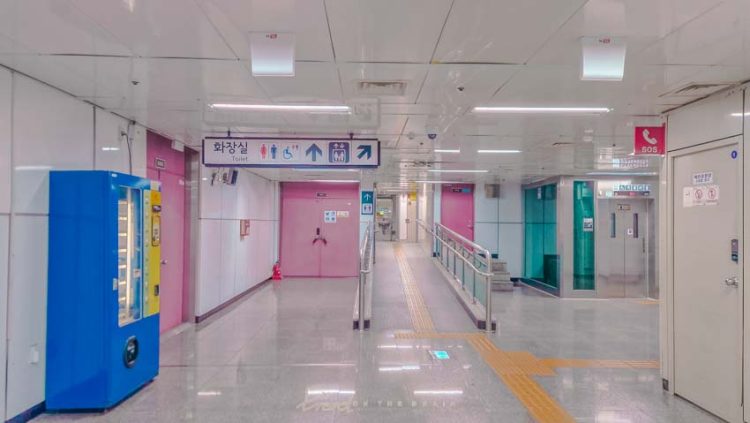
Don’t Clog up Toilets
In like half the places in Seoul I’ve visited – from public toilets to restaurants and hotels, you should not put toilet paper into the toilet bowl. The pipes can’t handle it.
There will be signs by the door (sometimes in English, but often with pictures) telling you if it’s ok to put the toilet paper into the toilet or the trash bin.
As always, sanitary products go into the bin – no exceptions.
Don’t Point or Gesture with Your Palm Facing Up
Pointing with your index finger or motioning someone with your palm up is considered rude.
You should use your whole hand with the palm down to gesture politely.
This is also the way to indicate someone to come to you. You keep your palm facing downwards and making a scraping motion towards you.
Palm upside motions are for commanding animals, as far as I heard.
Don’t Dress up Colourfully
This is a cultural norm that I happily ignore. But if you don’t want to stick out like a sore thumb and scream “tourist!”, sticking to the commonly seen colours is a good idea.
You’ll quickly notice the dress code: black, white, grey and beige. Colours might only be seen as accents, such as hats, bag or key charms.
The same goes for makeup. It should look more toned down and natural, rather than have bold colours and lines.
That being said: no one will make you abandon your style and fit in. (If they do, they have a problem.) Be your special snowflake. Just be aware that you might stand out more. But that’s ok.
Don’t Leave Cash at Home
You can easily get by just using your credit card in Seoul. However, especially with foreign cards, many machines where you order seem to struggle with reading them. I certainly have run into many instances, where I had to order at the till directly.
That’s not a problem, in such instances. But in some cases, you need to have cash on you. This can be the case with pop up street stalls, be it for clothing or food. Or food markets in general.
Typically, they only take cash. Also with photobooths, I found I can often only pay in cash (and only 1000 WON notes, too) since my credit cards are rejected there.
Same with recharging my climate card. I needed to insert cash.
You see, it’s definitely smart to have a few bills on you, just in case.

Don’t Film People
This should be common sense everywhere in the world really – especially if you want to post it online.
But the right of one’s own image is well protected in Korea. When you watch any Korean reporting or show, you will quickly notice people’s faces being blurred out when they are not figures of the public eye.
Even if you take street photos and people are clearly recognisable and especially if they’re central to the photo or video (and you didn’t get their explicit permission), their faces should be blurred out.
Taking photos on public venues, such as streets and in parks, falls in the legal category freedom of panorama. And the laws about it are strict in Korea. Just because you don’t know about them doesn’t mean you are exempt.
So think twice about what you post and how you are showing people.
Do Have a Korean phone number
It’s not a big deal if you don’t have a Korean phone number. You can easily get one with many e-sim providers, or when you get a sim card locally. Easiest is ordering online here* and picking it up when you arrive at the airport.
There are many public wifi hotspots all over Seoul, but I personally preferred having internet access pretty much everywhere. Because when you DO need to check for directions or opening times, there suddenly was no reception.
Plus, having Korean number – which the cheap esims don’t provide – allows you to get on waitlists at malls. These would be waitlists for getting into restaurants or pop-up stores.
If you don’t have a Korean phone number, you have to head back down and look for the reception to get a special code. I’ve always given up before that because it’s such a hassle. So having a number makes things just easy.
Do Take Your Passport
Typically, when I travel, I leave my passport in the hotel safe. It’s one of the most important documents, so you have to treat it carefully. (And always have a backup copy online, just in case. But that’s another story.)
And unlike Japan, you are not required to carry on with you always.
But as a tourist, you can take advantage of tax free offers. This means: For every 15000 WON spent, you get 1000 WON back. Many stores will deduct it right-away if you give them your passport to scan.
Big stores and malls also have tax free machines, where you can scan your receipts and passport to get the refunds. For all the purchases where you haven’t been able to do any of that, you can do it at the airport. That’s also where you would validate the tax free purchases and get the rest of the refund.
Do Clean Your Shoes
When you go hiking, you will come across stations with tubes for blowing air to cleanse your shoes. This is so you don’t cross contaminate spaces with seeds.
And it also helps clean your shoes from mud and dirt.